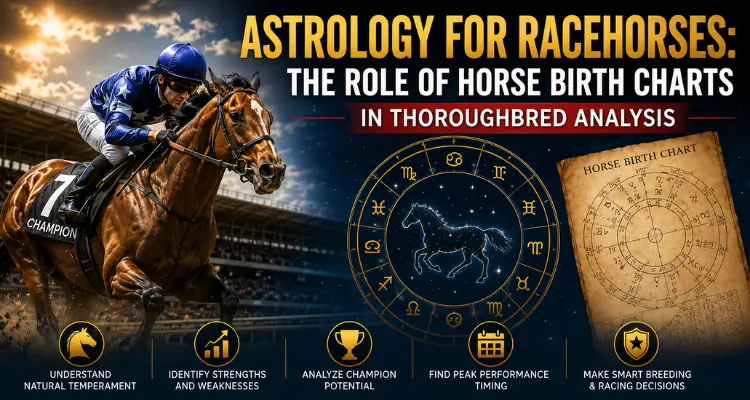
Every Thoroughbred horse is born with a temperament of its own. Some foals are bold from day one. Others stay cautious for years. Astrology for racehorses studies this difference through the horse’s birth chart, a map of planetary positions at the exact moment of foaling. Astrologers read three key elements in it: the planets, the zodiac signs they occupy, and the houses that shape drive, stamina, and mindset. Equine industry experts explore the best astrology for Thoroughbred horses for a simple reason. Pedigree papers show where a horse comes from. A birth chart suggests what the horse is like from within.
What is Natural Temperament in a Thoroughbred Horse?
Natural temperament is the behavior pattern a Thoroughbred horse is born with. It shows in how a foal reacts to noise, new places, and pressure, long before training begins.
- Alert, sensitive, quick to react, and full of forward energy. One horse is brave and pushy, another is intelligent but anxious, and a third stays calm until race day switches it on.
- Bloodline first, since sires and dams pass on behavioral tendencies. Early handling, stud farm environment, nutrition, and training routine shape the rest.
- Nervous horses need quiet preparation, and dominant horses need a firm routine. Misreading temperament leads to poor race placement, stress injuries, and short careers.
This inborn layer is exactly what racehorse astrology tries to read before the first gallop.
Read Also: What Makes a True Derby Horse? Temperament, Training, and Timing
The Role of a Horse Birth Chart in Astrology
The horse birth chart is the foundation of astrology for racehorses. Without it, an astrologer has nothing to read.
- Three exact details: the birth date, the birth time, and the birthplace. Stud farms that record the precise minute of birth give the cleanest chart.
- The ascendant (the rising sign), the Moon sign, and the positions of all planets across the twelve houses.
- The date fixes the planets, the time fixes the houses, and the location fixes the horizon. Change any one of the three, and the reading changes with it.
This is why Zodiac Gallops verifies foaling records before any racehorse astrology analysis begins.
Can Astrology Help Understand a Racehorse’s Natural Temperament?
Owners who use astrology for Thoroughbred horses say yes. Temperament is present at birth, and the birth chart is a record of that exact moment.
- A strong Mars placement points to an aggressive, front-running nature. A heavy Saturn influence suggests patience and staying power. The moon sign shows how the horse handles race-day pressure.
- One horse shows brilliant early speed but a weak response to stress. Another lacks raw pace but holds form over distance. Trainers build around strength rather than fighting weakness.
- No two charts match, just as no two horses match. For breeders comparing several foals from one bloodline, this individual reading is often the most useful part of astrology for racehorses.
How Birth Charts Help Analyze Champion Thoroughbreds
Champions tend to share certain chart patterns, and this is where racehorse astrology turns from description into selection.
- A snapshot of the sky at the moment of foaling, also called a natal chart, is plotted from the exact birth time and birthplace.
- The ascendant first for racing style, then the Moon for mental steadiness, then planet by planet through the houses.
- Mars governs speed and competitive fire, Saturn governs endurance and discipline, and planetary transits indicate peak performance windows for race scheduling.
- A well-placed Mars, a supportive Saturn, a stable Moon, and strong timing periods during the racing years. A horse with none of the four rarely wins, whatever its pedigree costs.
In astrology for Thoroughbred horses, these patterns separate a good pedigree from a genuine champion.
Also Read: The 5 Best Horse Racing Tracks in India & How to Choose Your Next Derby Winner
How Zodiac Gallops Analyzes Thoroughbred Horses Through Astrology
Zodiac Gallops was built by Sudheer Chauhan, a Vedic astrologer with more than 20 years inside the racing world and research spanning over 300,000 thoroughbreds. That research produced HAT (Horse Astro Technique) theory, the method behind every report and the reason many owners call it the best astrology for racehorses.
- Owners submit the foaling date, exact time, and birthplace. The team prepares the full chart and applies HAT theory to score natural ability, mental strength, and peak timing. From 50 stud farm foals, the analysis identifies the few with genuine winning potential.
- Each report describes how the horse handles training pressure, how it responds on race day, and which conditions suit it so trainers can match preparation to the animal.
- Every evaluation begins by confirming the foaling record, because HAT theory depends on precise planetary positions clean data in, reliable readings out.
- Trainers & bloodstock agents come here when the decision matters more than the price tag and when they want astrology for racehorses that protects prestige.
Conclusion
Astrology for racehorses gives owners a structured way to study what pedigree papers cannot show: the temperament and timing written into a horse at birth. It works best alongside bloodline study, veterinary checks, and a trainer’s own eye, not in place of them.
Temperament deserves multiple perspectives, and the horse birth chart is one worth having. For owners, breeders, and trainers who measure success in pride, astrology for Thoroughbred horses offers a view no other tool provides. If you want that view for your own stable, ZodiacGallops is ready to read the stars for you.
FAQs
Below are answers to some of the most common questions people ask about this topic.
Q1. How does astrology for racehorses work?
Racehorse astrology maps the planetary positions at the horse’s exact moment of birth, then interprets those positions to describe temperament, strengths, stamina, and likely peak performance periods on the track.
Q2. What information is required to create a horse birth chart?
Three details: the foaling date, the exact foaling time, and the birthplace. Accurate time matters most, since even small errors can change the chart’s ascendant and its reading.
Q3. Can astrology reveal a horse’s natural strengths and weaknesses?
Yes. Astrology for thoroughbred horses shows both sides of the animal: natural speed, endurance, and competitive drive on one hand, and stress sensitivity or inconsistency on the other.
Q4. How does Zodiac Gallops analyze Thoroughbred horses?
Zodiac Gallops prepares a full birth chart from verified foaling data, then applies HAT Theory, its own approach to astrology for thoroughbred horses, to assess ability, temperament, and peak timing in one report.
Q5. How Does Birth Chart Analysis Work for Racehorses?
The astrologer reads the ascendant for racing style, the Moon for mental steadiness, and each planet’s house position for drive and stamina, then combines them into one performance profile.
Q6. What makes Zodiac Gallops different from other astrology for racehorses platforms?
Zodiac Gallops runs on HAT Theory, developed by Sudheer Chauhan over more than 20 years of research on more than 300,000 thoroughbreds worldwide. That research base is why owners rate it the best astrology for racehorses.
Q7. How do planetary positions influence astrological interpretations for horses?
Each planet carries a role. Mars indicates speed and competitive fire, Saturn indicates endurance and discipline, and the Moon indicates emotional response under race-day pressure. Their signs and houses refine the reading.
Q8. What is the Zodiac Gallops HAT theory?
HAT (Horse Astro Technique) theory is the method behind the best astrology for racehorses at Zodiac Gallops. It blends Vedic astrology with racing research to identify the outstanding performer within any group of young horses.